
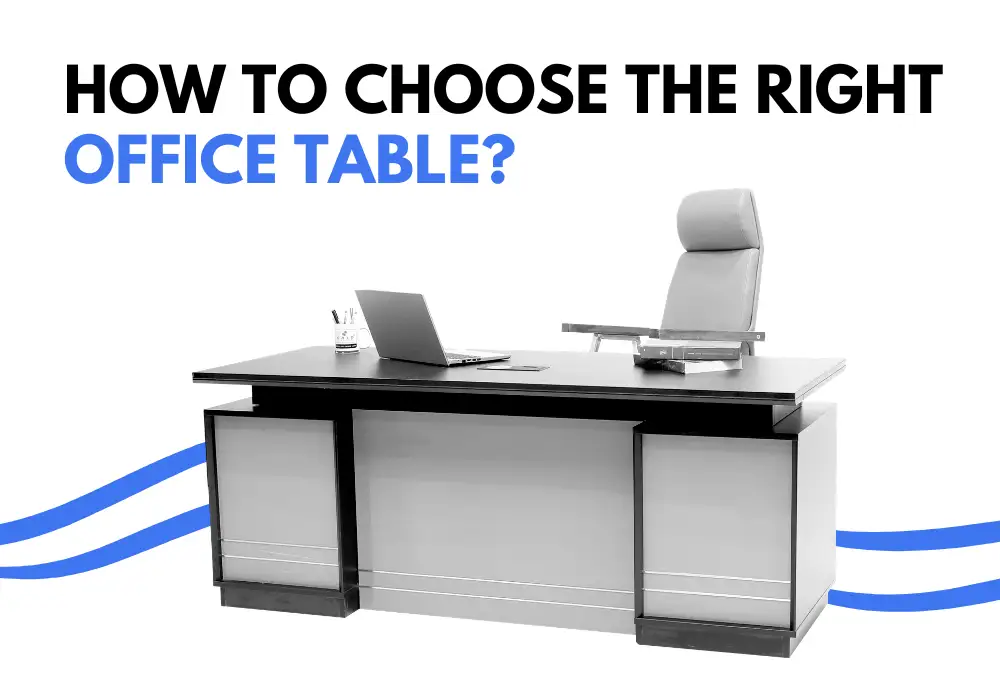
An office table is one of the most frequently used pieces of furniture in a workspace. Whether you spend eight hours working at a corporate office, manage a business, attend online meetings from home, or simply need a dedicated space for paperwork, the right table can make your workday much more comfortable and organized.
The wrong table, on the other hand, can leave your workspace feeling cramped, cluttered and uncomfortable. So, how do you choose the right office table? The answer depends on your available space, type of work, storage requirements, equipment and personal working style.
Here is a simple guide to help you make the right choice.
1. Start by Understanding Your Workspace
Before looking at designs and colours, look at the space where the table will be placed.
Measure the available floor area and consider where your chair will go, where people will walk and whether you need additional storage around the table.
A large executive desk might look impressive in a showroom, but it may not be the best choice for a small office.
Similarly, choosing a very compact table for a large workspace can leave you without enough room for your everyday work.
Think about:
- How much floor space is available?
- Where will the table be positioned?
- Will one person or multiple people use the area?
- Do you need space for visitors?
- Will you need a cabinet, bookshelf or side storage?
- Where are the electrical sockets located?
Taking these measurements before buying can save you from an expensive mistake.
2. Consider What You Actually Do at Your Desk
The best office table is not necessarily the biggest one. It is the one that fits your work.
For example, someone who mainly works on a laptop may not need the same desk as a designer working with two monitors, documents and other equipment.
Ask yourself what normally sits on your table.
Do you use:
- A laptop?
- One or two monitors?
- Keyboard and mouse?
- Files and documents?
- A printer?
- Telephone or other office equipment?
- Stationery and notebooks?
If your work involves several devices or paperwork, give yourself enough surface area to work without everything being piled on top of each other.
For a typical computer-based workstation, desk dimensions around 1200 × 600 mm are commonly used as a practical starting point, while larger setups may need more width or depth. The exact size should always be matched to the equipment and available space.
3. Choose the Right Table Size
Size is one of the most important factors when buying an office table.
A table that is too small can quickly become uncomfortable. Your laptop, monitor, keyboard, files and other essentials may compete for the same limited space.
A table that is unnecessarily large can consume valuable floor space.
As a general starting point:
Compact workspace:
A smaller desk can work well for laptop-based work, reception areas or limited rooms.
Standard workstation:
A medium-sized desk is suitable for everyday computer work, paperwork and office essentials.
Managerial or executive workspace:
A larger desk can provide additional working and meeting space while creating a more professional appearance.
Remember that dimensions are only part of the equation. The layout of your entire room matters too.
4. Don’t Ignore Desk Height
Desk height is another detail that is easy to overlook.
When you are seated, your shoulders should feel relaxed and your arms should be positioned comfortably while using the keyboard and mouse. You should also have enough room underneath the desk for your legs.
Many office desks in India are designed around a fixed height of roughly 72–76 cm, but the ideal setup depends on the user, chair and workstation arrangement.
If several people will use the same desk, pay particular attention to chair adjustability and legroom.
A good office table should allow you to work naturally rather than forcing you to adapt your posture around the furniture.
5. Think About Storage
Do you need drawers?
Maybe you need a side runner.
Or perhaps you prefer a clean tabletop with a separate cabinet.
Your storage requirements should influence the design you choose.
If you regularly handle files, stationery, documents or personal belongings, integrated storage can make a noticeable difference to your workspace.
For example, CRIO’s Nero Office Table features a side runner that provides additional storage while keeping the main work area spacious. Its listed dimensions are a 30 × 60 × 30-inch L-table with an 18 × 36 × 30-inch side runner.
The idea is simple: keep the things you need close without allowing them to take over your working surface.
6. Look for Practical Cable Management
Modern workspaces can quickly become messy because of cables.
Laptop chargers, monitor cables, extension boards, phones and other devices can leave wires running across the table and floor.
When choosing an office table, think about how your cables will be managed.
A good setup should ideally allow:
- Easy access to electrical points
- Neat routing of charging cables
- Minimal cables across the tabletop
- Safe positioning of extension boards
- Enough space behind the desk for wires
Cable management might not be the first thing you notice when looking at a table, but you will appreciate it every day once you start using it.
7. Choose a Shape That Matches Your Work
Office tables are available in different shapes, and each has its own advantage.
Straight Office Tables
Straight desks are simple, versatile and easy to position. They work particularly well in smaller rooms or traditional office layouts.
L-Shaped Office Tables
L-shaped desks provide more working surface while making efficient use of corners.
They are useful for people who need separate areas for computer work, paperwork or meetings.
CRIO’s current collection also includes the Arrow L-Office Table, which is designed around this type of workspace.
Executive Tables
Executive desks generally provide a larger working surface and a more substantial appearance. They can be a good choice for managers, business owners and private offices where the table is also part of the room’s overall design.
Reception Tables
Reception areas have different requirements. A reception table needs to look professional while providing enough room for computers, documents and day-to-day visitor interaction.
The important thing is to choose the shape according to your workflow rather than choosing a design simply because it looks attractive.
8. Pay Attention to Material and Build Quality
An office table is something you may use every working day for years.
That makes build quality more important than simply choosing the cheapest option.
Look at:
- Overall stability
- Quality of the tabletop
- Edge finishing
- Hardware and fittings
- Drawer or runner quality
- Surface finish
- Ease of maintenance
A good office table should feel stable when you are typing, writing or working with equipment.
CRIO states that its furniture is made using quality materials and branded accessories, with manufacturing involving German machinery and skilled workmanship.
When comparing tables, don’t judge quality only by appearance. Pay attention to the construction details as well.
9. Choose a Design That Fits Your Office
Function comes first, but appearance matters too.
Your office furniture contributes to the overall impression of your workspace.
For a modern office, clean lines and contemporary finishes can create a professional look.
For an executive cabin, a larger table with a sophisticated finish may suit the environment better.
For a home office, you may prefer something that blends with the rest of your furniture rather than looking like traditional corporate furniture.
The goal is to find a balance between functionality and aesthetics.
10. Think About Your Future Needs
A table that works today should ideally continue to work as your needs change.
Maybe you currently use only a laptop, but you may add a monitor later.
Maybe your business is growing and you will need additional storage.
Maybe your office layout will change.
Before buying, think beyond your current setup.
A little extra usable space can sometimes be worth the investment if it prevents you from replacing the table after a year or two.
11. Don’t Forget the Chair and Overall Setup
Even the best office table cannot create a comfortable workspace on its own.
Your desk and chair should work together.
When sitting at the desk:
- Your feet should be comfortably supported.
- Your shoulders should remain relaxed.
- Your arms should be positioned comfortably while typing.
- Your monitor should be positioned at a comfortable viewing distance.
- You should have enough legroom under the desk.
Think of the desk, chair, monitor and lighting as one complete workstation rather than four separate purchases.
Which Office Table Is Right for You?
There is no single office table that is perfect for everyone.
A small business owner may need a spacious executive desk. A home-based professional may prefer a compact workstation. A manager may want an L-shaped design with additional storage. A reception area may require a completely different configuration.
The right choice comes down to three questions:
What work do I do?
How much space do I have?
What do I need to keep on my desk?
Once you answer these questions, choosing the right office table becomes much easier.
Explore Office Tables at CRIO Furniture
At CRIO Furniture, you can explore a range of office tables designed for different workspace requirements. The current collection includes models such as Archer, Calvin, Focus, Kingstone, Nero, Prima-1 and Prima-2, giving you different options in terms of design, size and functionality.
CRIO also offers study and office furniture alongside its wider collection of bedroom sets, wardrobes, bookcases, LED units and other furniture.
If you’re setting up a new office or upgrading your existing workspace, take the time to choose a table based on how you actually work—not just how it looks.
The right office table should make your work easier, keep your workspace organized and feel comfortable every day.